


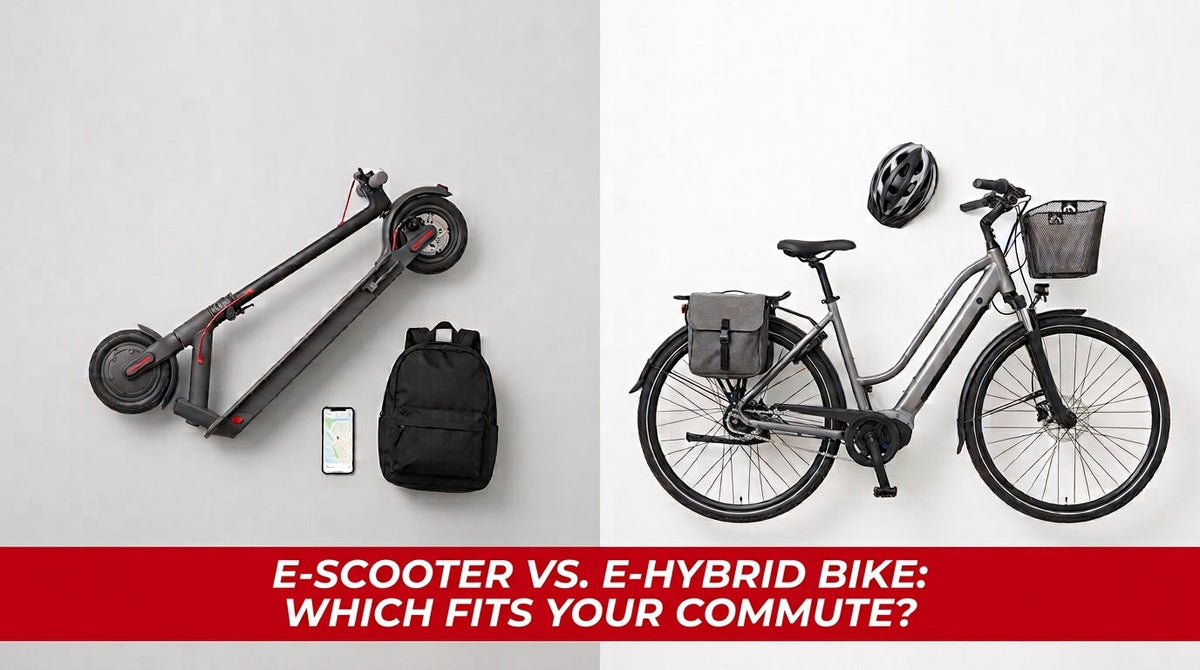
Ditching the car (or the crowded train carriage) for your daily commute? Two very different kinds of electric ride can get you there: a compact e-scooter you can fold and carry onto a train, or a full-frame e-hybrid bike built to handle the whole journey door to door.
Both are genuinely excellent ways to commute—but they solve slightly different problems. This guide compares them honestly, then walks through what to look for in either one and the different types available, so you can match the setup to your actual commute rather than just the hype.
In Summary
- E-scooters win on portability and upfront price; e-hybrid bikes win on range, weather handling, and cargo capacity.
- E-hybrid bikes are legally treated as standard bicycles nationwide—no licence or registration required.
- E-scooter rules vary significantly by state, and privately-owned e-scooters currently can't be ridden in public in NSW at all.
- Both run on lithium-ion batteries, so a few sensible charging habits go a long way.
- A helmet isn't optional on either one—it's a legal requirement in Australia.
- Budget for the extras: a decent lock, lights, and a spare tube if your scooter runs air-filled tyres.
In This Article
- E-Scooter vs E-Hybrid Bike: How They Actually Compare
- At a Glance: Our Top Picks
-
What to Consider When Choosing Your Setup
- 1. Scooter Motor & Power (E-Scooter)
- 2. Folding Mechanism & Carry Weight (E-Scooter)
- 3. Tyres: Air-Filled vs Solid (E-Scooter)
- 4. E-Bike Motor Type: Hub Drive vs Mid-Drive (E-Hybrid Bike)
- 5. Battery & Range (Both)
- 6. Frame Style: Step-Through vs Step-Over (E-Hybrid Bike)
- 7. Cargo & Weather Equipment (E-Hybrid Bike)
- Know the Rules Before You Ride
- Battery Care Basics
- Essential Gear for Your Commute
- Shop the Range
- So, Which Should You Choose?
E-Scooter vs E-Hybrid Bike: How They Actually Compare
| Factor | E-Scooter | E-Hybrid Bike |
|---|---|---|
| Portability & Storage | Folds down in seconds—carry it into an office, onto a train, or under a desk. | Needs a bike rack or dedicated storage space; not something you carry indoors. |
| Range Per Charge | Typically 30–70km, well suited to short-to-medium inner-city hops. | Often 60–100km+, better suited to longer or multi-stop commutes. |
| Cargo Capacity | Minimal—a small bag on your back is about the limit. | Pannier racks, baskets, and mudguards make carrying groceries or a laptop bag easy. |
| Terrain & Weather Handling | Small wheels struggle with potholes, gravel, and heavy rain. | Larger wheels and a stable frame cope far better with rough or wet conditions. |
| Upfront Cost | Generally the cheaper way in, with strong options under $1,000. | Higher starting price, but you're also buying a complete bike, not just a motor. |
| Long-Term Running Costs | Small, easily-worn tyres and modest battery packs may need earlier replacement. | Larger, more durable components generally mean a longer service life per dollar. |
At a Glance: Our Top Picks
| Best For... | Our Pick: | Key Highlight: |
|---|---|---|
| Portability | Segway Ninebot KickScooter E2 Plus II | Our lightest, most portable scooter—easy to fold, carry, and take with you the moment you step off. |
| Best Value | Segway Ninebot KickScooter E2 Pro | A genuinely popular entry point, with rear-wheel drive and built-in turn signals. |
| All-Rounder | Pedal Eagle ST Electric Hybrid Bike | Our #1 selling e-hybrid bike, with a step-through frame and a smooth mid-drive motor. |
| Range & Cargo | Cube Touring Hybrid ONE 600 | A Bosch mid-drive motor, 600Wh battery, integrated lights, mudguards, and a rear pannier rack. |
| Whichever You Choose | Cinettica Velocita Road Helmet | One of our best-selling helmets, essential whether you're riding a scooter or a bike. |
What to Consider When Choosing Your Setup
Whichever direction you're leaning, it helps to understand what actually separates a good setup from a great one. Here's what to look for.
1. Scooter Motor & Power (E-Scooter)
A scooter's motor type (single or dual wheel) and power output affects how well it handles hills and how quickly it gets up to speed. Entry-level single motor scooters are fine for flat, short commutes, but if your route includes any real inclines, look for a higher-powered or dual-wheel motor. An underpowered scooter can feel genuinely sluggish on even a moderate hill, and some budget models struggle to maintain speed once a rider's weight is added into the mix.
2. Folding Mechanism & Carry Weight (E-Scooter)
If part of your commute involves carrying the scooter—onto a train, up stairs, or into an office—the folding mechanism matters as much as the specs sheet. Look for a simple, one-motion fold that locks securely, and pay attention to the actual carry weight rather than just the advertised range or power, since a heavier scooter can quickly become a burden on a multi-leg commute.
3. Tyres: Air-Filled vs Solid (E-Scooter)
- Air-Filled Tyres: Offer a noticeably smoother, more comfortable ride over bumps and uneven footpaths. The trade-off is that they can be punctured, so a spare tube or repair kit is worth carrying.
- Solid Tyres: Puncture-proof and low-maintenance, making them a practical choice if you don't want to think about tyre pressure or repairs. They transmit more vibration through to the rider, so the ride is noticeably firmer on rough surfaces.
4. Motor Type: Hub Drive vs Mid-Drive (E-Hybrid Bike)
- Hub Drive: The motor sits in the bike's wheel hub, making it a simpler and generally more affordable system, well suited to flatter commutes and everyday riding. It doesn't perform quite as smoothly on steep or repeated climbs as a mid-drive system.
- Mid-Drive: The motor sits within the frame near the pedals, giving a more natural ride feel and stronger performance on hills. It's usually the pricier option, but it's the better choice if your commute includes any serious climbing.
5. Battery & Range (Both)
Battery capacity is measured in watt-hours (Wh)—the higher the number, the further you can ride before needing a charge. Real-world range depends heavily on rider weight, terrain, and how much you lean on the higher assist settings, so treat any advertised range figure as a best-case number. If your round trip is on the longer side, it's worth choosing a battery with some buffer above your actual daily distance.
6. Frame Style: Step-Through vs Step-Over (E-Hybrid Bike)
- Step-Through: A low, swooping frame that makes getting on and off easy, especially useful if you're commuting in work clothes or stopping and starting frequently. It's not usually the choice for riders prioritising the stiffest, most efficient frame for speed.
- Step-Over (Crossbar): The traditional frame shape, generally a little lighter and stiffer than a step-through design. It requires swinging a leg over the saddle to mount, which some riders find less convenient for frequent stops.
7. Cargo & Weather Equipment (E-Hybrid Bike)
If you'll be carrying groceries, a laptop, or gear, look for a bike with a rear rack rated for panniers or a basket, since not all e-hybrid bikes come with one fitted as standard. Mudguards keep road spray off you in wet weather, and integrated lights are a genuine convenience for early starts or late finishes, saving you from needing a separate light set.
Know the Rules Before You Ride
Rules for e-hybrid bikes are fairly consistent nationally: a compliant e-bike is pedal-assist, capped at 250W of continuous motor output, cuts assistance at 25km/h, and is treated the same as a standard bicycle in every state and territory—no licence or registration required. See the Australian Government's importer's guide to electric bikes for the national standard (EN15194).
E-scooter rules are far less consistent, and vary significantly by state. For example, in NSW it's currently illegal to ride a privately-owned e-scooter in any public place (that means footpaths, roads, shared paths, and bike lanes); with only government-run shared e-scooter trials permitted in designated areas. Other states and territories, including Victoria, Queensland, Western Australia, South Australia, Tasmania, the ACT, and the Northern Territory, do allow private e-scooter use under their own rules covering speed limits, rider age, and where you can ride. Always check your own state or territory's transport authority for the most up-to-date information before riding an e-scooter in public.
Battery Care Basics
Like any lithium-ion battery-powered device—laptops, power tools, phones—e-scooters and e-hybrid bikes are happiest when charged and stored sensibly. A few simple habits go a long way: use the charger that came with your device, charge on a hard surface away from exits and living areas, avoid leaving it charging unattended overnight, and stop using a battery that's swollen, leaking, or visibly damaged. It's also worth looking for a genuine compliance mark on the battery and charger before you buy, and it only takes a minute to check for current recalls at the ACCC's Product Safety Australia. For general information, Fire and Rescue NSW publishes a straightforward guide to e-bike and e-scooter battery care. As with all regulatory matters, it's best to check with your local state or territory for any battery safety rules.
Essential Gear for Your Commute
Scooter or bike, one piece of gear isn't optional: a proper helmet. Both e-scooters and e-hybrid bikes can reach speeds well above a casual walk or pedal, and in most parts of Australia a helmet is a legal requirement on either one—not just good sense.
- A Helmet: Look for a snug, adjustable fit with a secure retention system, good ventilation for warmer commutes, and a lightweight shell that's comfortable to wear for the full trip. Browse our range of recreational helmets.
- Lights: A front and rear light set makes a genuine difference for early starts, late finishes, or any low-light riding—and in most parts of Australia, lights are a legal requirement after dark. Browse our range of front and rear light sets.
- A Reliable Lock: Both e-scooters and e-hybrid bikes are a real investment, and commuting means parking in public more often than not—at train stations, cafes, or outside the office. Check out our range of bike locks.
- Storage: A Bag, Backpack, or Panniers: A well-fitted backpack works for either setup, while a rear rack and panniers on an e-hybrid bike keep the weight off your back entirely—handy if you're regularly carrying a laptop or groceries. Browse our range of backpacks and panniers.
- Hi-Vis Clothing: Riding in traffic means being seen matters just as much as seeing where you're going, especially at dawn or dusk. See our range of hi-vis clothing.
- Wet Weather Gear: Whichever your choose, a lightweight, packable rain jacket means an unexpected downpour doesn't have to mean arriving at work soaked. Browse our range of wet weather and waterproof jackets.
- A Phone Mount: A stable, handlebar-mounted holder makes following directions on an unfamiliar route far easier and safer than trying to check your phone from a pocket. See our range of phone mounts.
Shop the Range
Ready to compare for yourself? Browse our full range of electric scooters and electric hybrid bikes, or explore trusted brands like Segway Ninebot, Cube, and Merida.
So, Which Should You Choose?
There's no universally right answer—just the option that matches your actual commute.
- Choose an e-scooter if: part of your journey is by train or bus and you need something you can fold and carry, your commute is short-to-medium and mostly on smooth footpaths or bike paths, or you want the lowest possible upfront cost—and your state allows private e-scooter use in public.
- Choose an e-hybrid bike if: your commute is longer or hillier, you regularly carry a bag, laptop, or groceries, you ride in all weather, you want a single setup that handles the entire trip door to door, or you're in a state where private e-scooters aren't yet road-legal.
- Not sure? Consider your worst-case day: if a sudden downpour or a flat tyre would leave an e-scooter commuter stranded, that's a strong signal an e-hybrid bike's sturdier build and cargo capacity are the safer long-term bet.


