


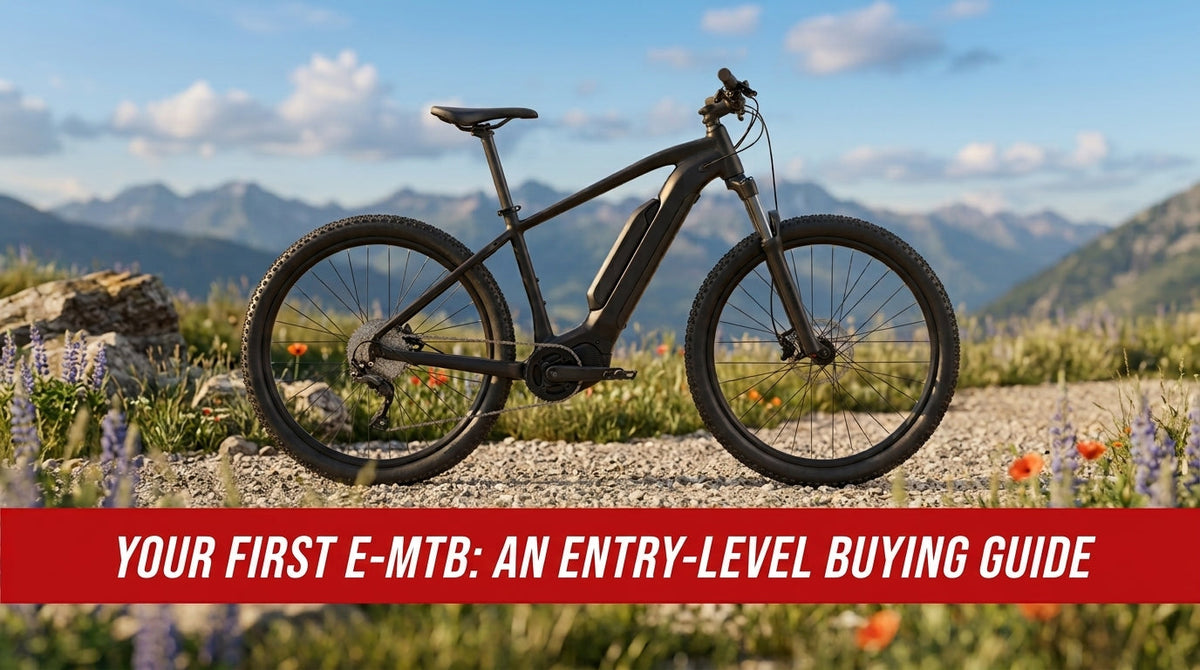
Thinking about making the switch to an electric mountain bike? You're not alone. Electric mountain bikes have quickly become one of the most popular ways to get onto the trails—flattening climbs, extending your ride time, and opening up terrain that might've felt out of reach before.
But with dozens of models, motor systems, and suspension setups on the market, picking your first electric mountain bike can feel overwhelming. This guide breaks down exactly what to look for, the different types of electric mountain bikes on the market, and the accessories worth having from day one—so you can buy with confidence, whatever your budget.
In Summary
- Motor type is the biggest decision: hub-drive is cheaper and simpler, mid-drive climbs and handles rough trails better.
- Hardtails suit fire roads and commuting; dual-suspension earns its extra weight and cost on genuinely technical trails.
- Treat advertised battery range as a best case, not a guarantee—it varies a lot with terrain and rider weight.
- Hydraulic disc brakes and an alloy frame are the sensible defaults for a first electric mountain bike.
- Budget for a helmet, lights, a lock, and hydration/storage from day one.
In This Article
- At a Glance: Our Top Picks
- What to Consider When Choosing an Electric Mountain Bike
- Common Types of Electric Mountain Bikes
- Quick Glossary: E-Bike Terms Worth Knowing
- Know the Rules Before You Ride
- Essential Accessories for Your First Electric Mountain Bike
- Our full list of first E-MTB recommendations
At a Glance: Our Top Electric Mountain Bike Picks for First-Time Buyers
| Best For... | Our Pick: | Key Highlight: |
|---|---|---|
| Under $3K | Pedal Lynx 3C Electric Hardtail | Our best-selling entry-level electric mountain bike. With 70km range, an 80Nm mid-drive motor and 100mm front suspension. |
| Overall | Cube Reaction Hybrid Performance 600 | Cube's top-selling hardtail electric mountain bike, backed by decades of German engineering pedigree. |
| Best Value Dual-Suspension | Merida eOne-Forty 400 | Our best-selling full-suspension electric mountain bike overall, with genuine trail-ready capability and Merida's trusted engineering. |
| Best for Commuting | Cube Reaction Hybrid Performance 600 FE Easy Entry | A step-through frame plus integrated lights, mudguards, a kickstand, and carrier points—genuinely ready for daily commuting straight off the showroom floor. |
What to Consider When Choosing an Electric Mountain Bike
Choosing an electric mountain bike is about matching its features to how and where you actually plan to ride. Here's what to look for.
1. Motor Type: Hub Drive vs Mid-Drive
This is the single biggest decision you'll make on an electric mountain bike, and it affects everything from price to how the bike actually rides on the trail.
- Hub Drive: The motor sits in the wheel hub, making these systems simpler, lighter on the wallet, and lower-maintenance. They're a great match for fire roads, groomed trails, and commuting. The trade-off is that a hub motor adds extra weight right at the wheel—weight that has to bounce and move with every bump instead of being cushioned by the suspension—which can make the bike feel less composed on rough, technical terrain. That's why they're generally not the right tool for aggressive, rocky descents or serious off-road trails.
- Mid-Drive: The motor sits near the bike's centre of gravity and drives power through the pedals and chain, giving a more natural, balanced ride feel and better performance on steep or technical climbs. Mid-drive systems put more strain through the chain and gears, so those parts on a hard-ridden mid-drive bike tend to wear faster and need replacing sooner. They're also usually the pricier option, but it's what you'll find on most bikes built specifically for serious trail and off-road riding.
2. Battery & Range
Battery capacity is measured in watt-hours (Wh)—the higher the number, the further you can ride before needing a charge. Entry-level electric mountain bikes typically carry a 400–500Wh battery, good for a couple of hours of mixed trail riding, while higher-end bikes push toward 600–700Wh+ for longer days out. Range in the real world depends heavily on terrain, rider weight, and how much you lean on the motor's higher assist settings, so treat any advertised range figure as a best-case number rather than a guarantee. Most electric mountain bike batteries take 3–6 hours for a full charge, so an overnight charge is usually all you need before your next ride.
3. Frame Type: Hardtail vs Dual Suspension
- Hardtail (front suspension only): Lighter, simpler to maintain, and generally more affordable, since there's no rear shock to service. A hardtail is an excellent choice for fire roads, light, narrow trails, and commuting, but the lack of rear suspension means rougher, rockier trails transmit more impact straight through to the rider.
- Dual Suspension (front and rear): A rear shock soaks up impacts on technical terrain, keeping your rear wheel planted and giving you far more control and comfort on rough descents. The trade-off is extra weight, a higher price tag, and a rear shock that will eventually need servicing—worth it if your local trails are genuinely technical, but often more bike than you need for smoother terrain.
4. Suspension Travel
Travel refers to how far the suspension can compress, measured in millimetres, and it should match the terrain you actually ride rather than the terrain you aspire to ride. Around 100mm of front travel suits fire trails and light, narrow trails, 120–140mm covers most all-round trail riding, and 150mm or more is built for aggressive, technical descents. More travel isn't automatically better—it adds weight and reduces pedalling efficiency, so a heavily-travelled bike can feel sluggish and overbuilt if most of your riding is on smoother trails.
5. Brakes: Why Hydraulic Disc Matters More on an Electric Mountain Bike
Electric mountain bikes are heavier than standard mountain bikes thanks to the motor and battery, and pedal assist means you'll often be travelling faster too. That combination puts more demand on your brakes, which is why hydraulic disc brakes—not mechanical or rim brakes—are the standard on virtually every electric mountain bike worth buying. They offer stronger, more consistent stopping power in wet or muddy conditions, which matters even more when there's extra weight and speed to manage.
6. Frame Material: Alloy vs Carbon
Most entry-level and mid-range electric mountain bikes use an aluminium alloy frame—strong, durable, and easy to repair if it ever takes a hit, at a more accessible price point. Carbon frames shave off meaningful weight (a real benefit given how heavy the motor and battery already make an electric mountain bike) and often ride with a bit more precision, but carry a higher price tag and are more expensive to repair if damaged. For a first electric mountain bike, alloy is the sensible, proven choice—carbon is worth considering once you know exactly how and where you'll be riding.
Common Types of Electric Mountain Bikes
"Electric mountain bike" covers a genuinely wide range of bikes built for very different kinds of riding. Matching the type to your actual riding style matters more than chasing the highest spec sheet.
Hardtail Electric Mountain Bike: The most common starting point, and usually paired with a hub-drive motor. Great for fire roads, groomed, narrow trails, and even doubling as a commuter thanks to the lower weight and simpler maintenance. It's not the right choice if your local trails are rocky, root-covered, or feature sustained technical descents—that's exactly the terrain a hardtail (and a hub motor) struggle with.
Trail Dual-Suspension Electric Mountain Bike: Usually running 120–140mm of travel and a mid-drive motor, this is the genuine all-rounder for riders who tackle a real mix of terrain—flowing, narrow trails, moderate climbs, and the occasional rocky or root-covered section. It's more bike than you need if you're sticking to smooth, wide trails, but it's the sweet spot for most regular trail riders.
Enduro Dual-Suspension Electric Mountain Bike: Built with 150mm+ of travel, a lower, more stable frame design, and a mid-drive motor to match, these bikes are designed for aggressive, technical descents and bike park laps. That capability comes at a cost—they're heavier, less efficient on flatter trails, and typically the most expensive category of electric mountain bike. Not the ideal first bike for someone still building trail confidence, but the right tool if you already know you're chasing steep, rough terrain.
Quick Glossary: E-Bike Terms Worth Knowing
A few more terms come up often when shopping for an electric mountain bike. Here's a quick reference.
- Pedal Assist: The motor only adds power while you're actively pedalling, rather than driving the bike on its own—this is what keeps a compliant electric mountain bike classified as a bicycle rather than a motor vehicle.
- Assistance Level: The mode you select (often labelled something like Eco, Trail, or Sport) that determines how much help the motor gives for your pedalling effort. Higher modes give more assistance but drain the battery faster.
- Torque (Nm): A measure of the motor's rotational force, in newton-metres. Higher torque helps with steep climbs and quick acceleration, though how powerful a bike feels also comes down to its software and gearing.
- Cadence: How fast you're pedalling, in revolutions per minute. Many mid-drive motors perform best within a certain cadence range, so shifting to an easier gear on a climb can help the motor work more efficiently.
- Motor Cut-Off: The speed at which the motor stops assisting—25km/h for a legal e-bike in Australia. You can still pedal or coast faster than this; you're simply doing it without help from the motor.
- Peak Power vs Continuous Power: Continuous power is what a motor is rated to sustain over time (legally capped at 250W), while peak power is the higher output it can briefly produce on a steep climb. A brief spike above 250W doesn't make a bike non-compliant.
- Range Anxiety: The worry that your battery will run out before you finish riding. Since a compliant electric mountain bike is still a genuine bicycle, you can always keep pedalling home unassisted if the battery runs flat.
Know the Rules Before You Ride
Rules around e-bike power, speed, and rider age can vary by state and are subject to change. Australia's national standard for a legal e-bike—a maximum continuous motor output of 250W, pedal assistance that cuts out at 25km/h, and compliance with the EN 15194 standard—is set out by the Australian Government's importer's guide to electric bikes, which also links out to the specific rules for your own state or territory.
Essential Accessories for Your First Electric Mountain Bike
A few extras make a real difference to safety and convenience once you're out on the trail.
- A Proper Mountain Bike Helmet: Electric mountain bikes carry more speed than a standard mountain bike, so a helmet with extended rear coverage and MIPS rotational protection is worth the investment. Browse our range of mountain bike helmets.
- Lights: Even if you're not planning night rides, a front and rear light set is genuinely useful for early starts, late finishes, or any road riding between your door and the trailhead. See our range of front and rear light sets.
- A Reliable Lock: Electric mountain bikes represent a serious investment, so a solid lock is worth having for trailhead car parks, cafe stops, or anywhere you need to step away from the bike. Check out our range of bike locks.
- Hydration & Storage: Longer trail rides mean carrying water, a spare tube, and basic tools. A hydration pack or a simple frame-mounted bottle cage covers most riders' needs. Browse our hydration packs and water bottles.
- A Bike Computer or GPS: Handy for tracking battery use, distance, and elevation gain—especially useful while you're still learning how far a charge will actually take you. See our range of bike computers.


